
💡 Why Do Different Positions Use Different Bulbs Even Though They're All T10?
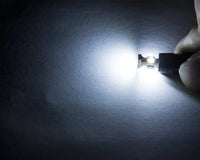
If you've ever replaced a car bulb yourself, you're likely familiar with the "T10" standard. It's the most common "wedge base" bulb size, often used for license plate lights, interior map/dome lights, and back-up lights etc.
Since they all look alike and fit the same socket, why do some only draw 0.5W while others can go up to 10W or higher? The answer lies in a design philosophy driven by efficiency, stability, and crucial structural space limitations.
🔍 The T10 Bulb: Same Base, Totally Different Design
The designation "T10" (or common equivalents like 194/168/W5W) primarily defines the bulb's base size and outer diameter. However, within this single standard, automotive engineers adjust the internal light source based on the "Application Context," determining its wattage, light direction, and thermal management structure.
1. Interior Lights: Maximizing Luminous Efficacy (Direct Downlighting)
The primary goal of interior lighting, such as dome or map lights, is the highest localized illumination efficiency.
- Design Focus: The fixture structure dictates that the bulb's light-emitting surface must cast the light straight down. For an LED T10, this means using a forward-facing or directional chip arrangement.
- Rationale: This ensures the light beam is concentrated, minimizing light wasted by ineffective reflection or scattering inside the housing. The light needs to be precisely focused on the necessary area (like a reading space), maximizing the conversion of electrical energy into practical light.

2. License Plate Lights: The Dual Constraint of Stability and Space (Long Duration, Low Wattage)
The license plate light is the most "reserved" T10 application. It sacrifices brightness for extreme stability and is subject to stringent physical space limitations.
- Long-Duration Requirement: License plate lights are essentially on continuously whenever the headlamps are activated. To ensure the bulb operates stably for long hours and avoids premature failure from overheating, a low-wattage design (typically around 0.5 Watts) must be chosen.
- Physical Space Constraint: License plate lamps are installed in very tight housings around the plate; the space is not large. This tiny fixture cannot accommodate large, high-heat bulbs. The low-wattage T10 ensures low heat generation, long life, and easy integration into the restricted fixture space.

3. Cargo/Trunk Lights: Overcoming Structural Limits (Side or Wide-Angle Emission)
The design of cargo or trunk lights prioritizes overcoming the physical space limitations of the vehicle's internal structure while achieving uniform illumination.
- Design Focus: Since the fixtures must be flattened and integrated flush into the side or top trim panels, the T10 used here often employs side-emitting or wide-angle LED chips.
- Rationale: This design allows the light to effectively spread from the edges, illuminating the entire cargo area, all while conforming to the spatial constraints that require the fixture to be thin and discreet.
(Note: While high-power functions like reversing lights typically use the larger T15/921 specification, the same principle of matching power to application applies.)

4.Back-up Lights (Emergency Need: Instant High Brightness)
Reversing lights are used in brief, high-risk situations, demanding extremely high brightness and instantaneous power output.
-
Design Focus: Generally requires a brighter and higher-wattage source. For example, basic versions are around 5 Watts, while some may reach nearly 10 Watts (e.g., S22).
-
Rationale: High brightness is essential to illuminate the road and obstacles behind the vehicle and provide a strong warning signal. Since reversing is not a sustained action (very short usage time), the bulb can handle a higher power output for a short duration, prioritizing instantaneous high brightness over long-term stability.

✅Conclusion: Identical Base, Diverse Function
Though your car may be filled with T10 specification bulbs, their core design purpose and internal configuration are entirely different. From the efficiency-driven interior light to the space-constrained license plate light and the structure-conforming cargo light, every small T10 bulb represents the optimal trade-off engineers made between "Functional Needs," "Physical Limitations," and "Durability."
The next time you replace a T10 bulb, remember: "Same base" does not mean "same function." Choosing the design that matches the application context is key to achieving the best illumination and longest lifespan.